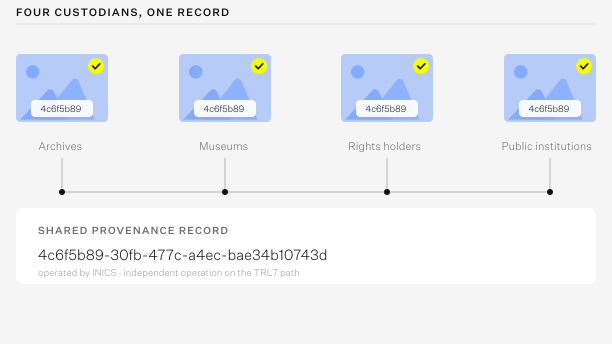
Keep media linked to its provenance.
puit.is embeds an imperceptible Media UID in the media signal at or near the source. After redistribution or editing, the UID can be recovered from the copy alone and resolved to its provenance record, even when the metadata no longer travels with it.

EIC Accelerator Step 1 passedInvited to Step 2 in July 2026Live EU-hosted betaReady for integration testing98.5% UID recoveryAfter manual WhatsApp transfer · 985/1,000
Results reflect documented test conditions. EIC evaluation is ongoing; puit.is is not EIC-funded.
Proof. Protect. Preserve.
Every export, compression, or migration can sever a digital object from its origin. puit.is adds a provenance layer designed to survive that journey.
A unique identifier is the bridge. The record preserves evidence of origin, attribution, and continuity as media moves across platforms.
A unique identifier is the bridge. The record preserves evidence of origin, attribution, and continuity as media moves across platforms.
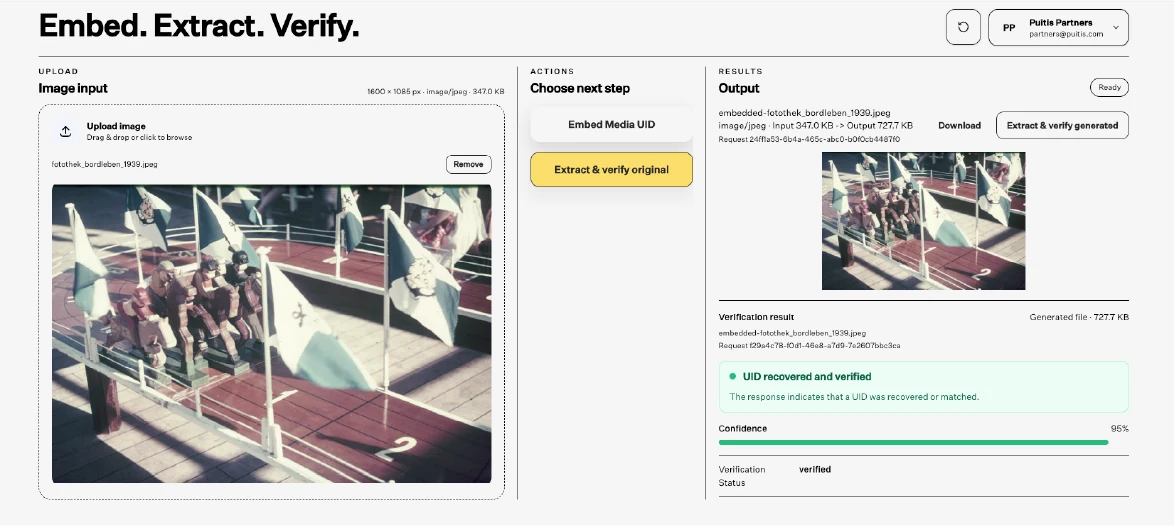
The confidence value describes how certain the payload recovery is. It is not a judgement about the picture.
Content. Context. Confidence.
Verification should return evidence, not a verdict. puit.is reports what was recovered, how confident the match is, and how far it sits from the stored record.
Repeatable checks you can inspect, rerun and reconcile years later.
Repeatable checks you can inspect, rerun and reconcile years later.

Embed. Extract. Verify.
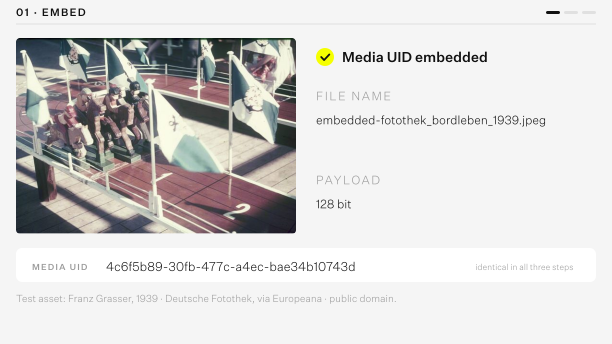
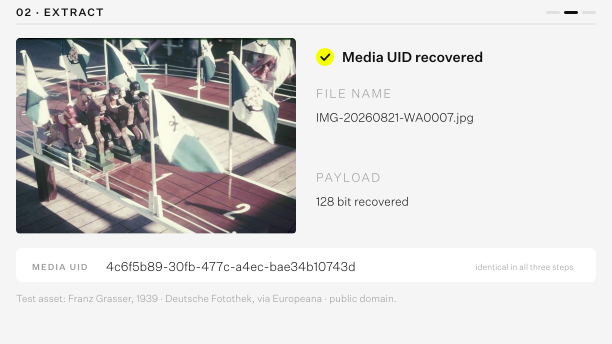
An imperceptible signal embedded at source, linked to an off-chain provenance record and a separate UID-derived public commitment. Designed to remain recoverable after compression, edits, or migration.
Embed at source
Attach provenance before the file starts moving.
Extract later
Recover the signal after edits, compression, migration, or reposting.
Verify later
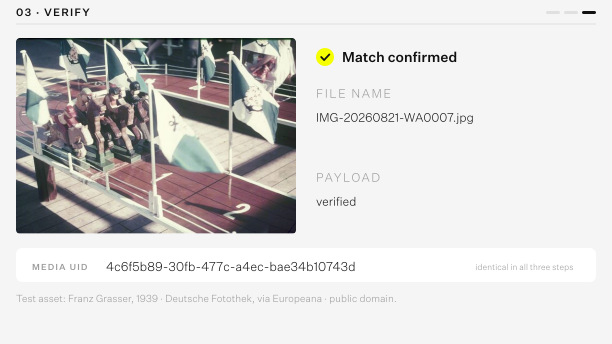
Returns recovery, match distances and a graded status.
Built first where continuity matters most.
Archives, museums, rights holders, and public institutions are where digital origin first becomes non-negotiable.
The same need is spreading across media, licensing, and AI-generated content. puit.is starts with high-consequence provenance and scales from there.
The same need is spreading across media, licensing, and AI-generated content. puit.is starts with high-consequence provenance and scales from there.