Partners

Test shared provenance in a real workflow.

puit.is works with archives, newsrooms, platforms, research teams, and technical specialists to test whether a media-bound UID can preserve a checkable link to origin after redistribution, transformation, and metadata loss.

Current hosted tests run on EU infrastructure. Images are the supported media type today.

Current test path

  1. 1Original image
  2. 2Imperceptible UID embedded
  3. 3Copy, resize, recompress, or redistribute
  4. 4Verification status, confidence, and match distances
  5. 5Issuer-controlled record and public commitment

Who this is for

Built for workflows where provenance gets lost.

The strongest partner tests start with an existing redistribution or transformation path—not a hypothetical demo.

Archives & collections

Test provenance through digitisation, IIIF derivatives, format migration, publication, and reuse.

Newsrooms & media

Test resizing, recompression, syndication, social redistribution, and editorial hand-offs.

Platforms & technical teams

Evaluate watermark and verification endpoints, batch processing, and integration into existing media services.

Research & technical collaboration

Define reproducible evaluations or explore collaboration around watermarking, verification, infrastructure, security, and interoperability.

Why test now

Metadata is useful—until it is separated from the file.

Publishing systems, messaging platforms, derivative generation, and format migration can remove or disconnect metadata and manifests. Exact file hashes also change after normal transformations.

Why test now

puit.is keeps a recoverable identifier in the media signal.

An imperceptible UID links the asset to an issuer-controlled provenance record and a public tamper-evident commitment. The goal is continuity of origin evidence across systems—not a claim that the content itself is true.

Test packages

Choose the level of test that matches your readiness.

Every test is bounded by an agreed asset set, workflow, configuration, and acceptance criteria. Results include limitations—not only successful recoveries.

Best for

Asset recovery test

A first technical validation without workflow integration.
You provide
A bounded set of licensed images, the transformations or distribution path to reproduce, and permission to process the agreed assets.
We test
UID embedding, the defined transformation path, recovery behaviour, verification status, and negative controls.
You receive
A versioned run summary, per-item results, observed failure modes, and a recommendation for the next integration step.

Best for

Workflow integration test

Teams ready to connect a sandbox workflow, DAM, publishing system, or media service.
You provide
A technical contact, sandbox or test workflow, representative assets, and agreed success criteria.
We test
Watermark and verification endpoints, data flow, authentication, batch behaviour, and the agreed redistribution path.
You receive
Integration notes, a reproducible test record, acceptance results, open issues, and a proposed path to a pilot.

Best for

Independent validation study

Universities, laboratories, and institutions that want a neutral, reproducible evaluation.
You provide
A validator-led protocol or jointly defined test plan, test assets or datasets, and the intended reporting model.
We test
Versioned configuration, benchmark tooling, technical clarification, and reproducibility artefacts within the agreed scope.
You receive
A documented result set and limitations suitable for a confidential report or separately agreed public validation output.

Fixed prices, durations, and asset counts are agreed during scoping rather than published as generic promises.

Integration modes

Start with the mode that fits your readiness.

Recommended first test

Reproducible batch test

Run a bounded asset set and defined transformations with per-item outputs, run metadata, and evidence artefacts.

Available for scoped tests

Hosted REST API

Watermark and verification endpoints with OAuth2/Keycloak-based access for controlled sandbox integration.

Available as a scoped integration

Workflow adapter test

Map puit.is into a specific IIIF, DAM, CMS, publishing, or media-service workflow. This does not claim generic production connectors for every platform.

Prototype validation

Two-node prototype

Cross-provider record replication and verification have been demonstrated in a two-node prototype. This is not the current production topology.

Production today is operated by INICS through a single hosted service. Multi-operator production remains a TRL7–8 objective.

Test process

A bounded path from question to evidence.

  1. Step 1

    Scope the question

    Define the workflow, assets, permissions, transformation path, and decision the test should support.
  2. Step 2

    Freeze the protocol

    Agree versions, configuration, success criteria, negative controls, and how results may be used.
  3. Step 3

    Run and inspect

    Execute the agreed test and review per-item results, match statistics, and failure cases.
  4. Step 4

    Choose the next step

    Close the test, refine the protocol, proceed to integration, or define an operational pilot.

Partner inputs

What we need from a partner

  • A real use case or workflow question
  • Representative assets with processing permission
  • The intended transformation or redistribution path
  • A technical or operational contact
  • Agreed success criteria
  • Data, security, or publication restrictions

Test outputs

What you receive

  • A bounded test plan
  • Versioned configuration and run context
  • Per-item results and summary metrics
  • Negative-control and failure-case observations
  • Clear limitations and unresolved questions
  • An integration or validation recommendation
  • Evidence artefacts appropriate to the agreed scope

A test result is evidence about a defined configuration and workflow. It is not a universal claim about all media, edits, or deliberate removal attacks.

Data handling

What happens to test media and provenance data?

The following describes the current hosted test mode. Any different deployment or retention requirement must be agreed during scoping.

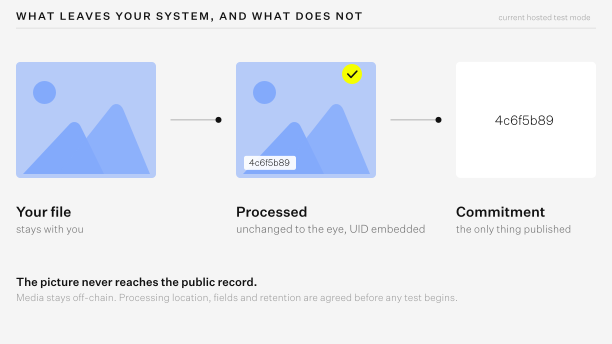
Media stays off-chain.

Media is uploaded to the INICS-operated EU-hosted API, processed in object storage, and returned as a watermarked copy. Verification uploads are temporary test data within the agreed workflow.

The record stores identifiers and verification data.

The current record contains a GUID, 128-bit watermark payload, PDQ-256 perceptual fingerprint, timestamps, and owner identifier. Media itself is not stored on a blockchain.

Only a UID-derived commitment is publicly anchored.

A SHA-256 commitment derived from the GUID is batched into a Merkle root and anchored to Bitcoin. The public anchor contains no media, fingerprint, or descriptive metadata.

The current hosted production service is single-operator. The architecture is ledger-agnostic by design and Bitcoin-anchored in practice; Bitcoin/OpenTimestamps is the implemented anchor path today.

Evidence

Evidence before claims.

12,331

unique images

160,303

controlled transformations

61,655

negative controls

98.5%

UID recovery after manual WhatsApp transfer · 985/1,000

Results reflect documented benchmark versions, configurations, and test conditions. They do not imply equivalent performance across all edits or deliberate removal attacks.

Aggressive geometric edits, AI-based removal attacks, and heavy compositing remain active work. We publish what breaks, not only what survives.

Independently evaluated.

puit.is passed Step 1 of the EIC Accelerator with a score of 3.00/4.00 and was invited to Stage 2 in July 2026. Evaluators judged all aspects of TRL 5 convincingly completed, with evidence supporting the claimed TRL 6.

The EIC Accelerator evaluation is ongoing; puit.is is not EIC-funded.
FAQ

Frequently asked questions

Does puit.is decide whether content is true?

No. puit.is provides evidence about origin, continuity, and the relationship between media and a provenance record. It does not judge whether content or an underlying claim is true.

Do you store media on Bitcoin?

No. Media, perceptual fingerprints, and descriptive metadata remain off-chain. The public anchor contains a Merkle root over commitments derived from asset identifiers.

Does media have to leave our environment?

In the current hosted test mode, files are uploaded to the INICS-operated EU-hosted service for processing. Different deployment or retention requirements must be agreed during scoping.

Which media types are supported?

Images are supported today. Audio, video, documents, and 3D assets are research or roadmap areas, not current production capabilities.

Is the current network already decentralised across independent operators?

No. Production is currently single-operator and INICS-controlled. Cross-provider replication and verification have been demonstrated in a local two-node prototype.

Do published metrics apply to every transformation?

No. Results are specific to documented versions, configurations, datasets, and test conditions. Aggressive geometric edits, AI-based removal, and heavy compositing remain active work.

What does a first test normally involve?

The lowest-friction route is a bounded batch test using representative images and an agreed transformation path. Workflow integration and independent validation can follow once the initial question is clear.

Can results be published?

Publication scope is agreed before the test. Results may remain confidential, support an internal decision, or be converted into separately approved public wording.

Support

Open doors & share expertise.

Not every useful collaboration starts with an integration test. We also welcome targeted introductions and expertise that can strengthen validation, standards alignment, institutional adoption, governance, or technical delivery.

  • Introductions to newsrooms, archives, platforms, and potential integration partners
  • Connections to independent laboratories and university research groups
  • Expertise in media standards, provenance, digital heritage, and regulatory implementation
  • Access to relevant industry, policy, or standards communities
  • Technical review of watermarking, verification, security, infrastructure, or interoperability

Partner request

Scope a partner test or collaboration.

Tell us what you want to test, where provenance currently breaks, or how you would like to collaborate. We will use this information to prepare the most relevant first conversation.

Add more detail

By submitting this form, you agree that puit.is may use the information provided to respond to your enquiry. See our Privacy Notice.

Do not submit sensitive media, credentials, or private diligence documents through this form.

Prefer email? Write to partners@puitis.com.