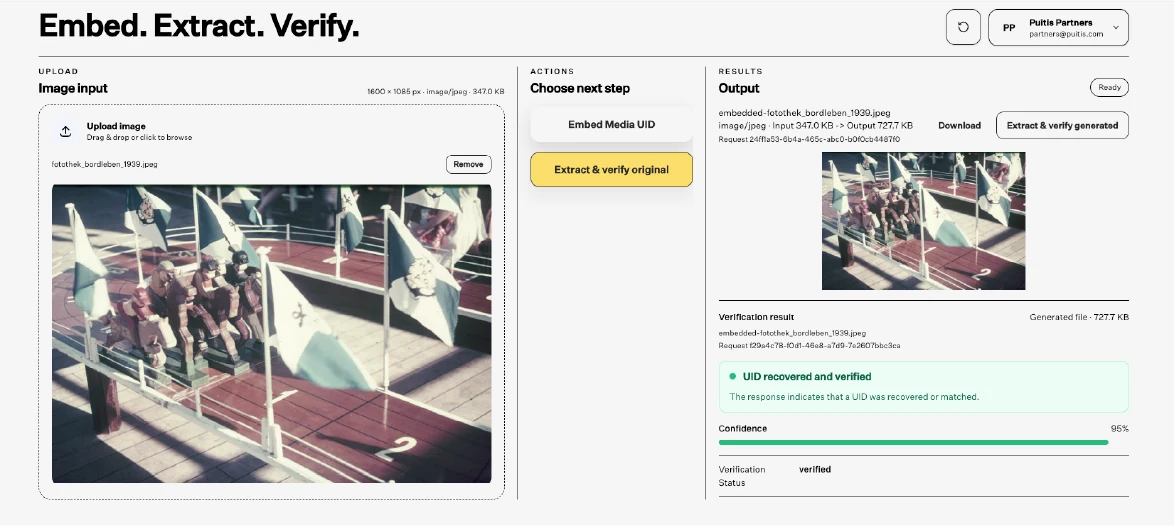

Solution - proof of origin that survives beyond publication.
It is built for cultural heritage, institutional records, and high-consequence media workflows where origin must remain verifiable beyond one platform, one database, or one moment in time.

Measured where provenance usually breaks.
Provenance systems often work while files remain untouched. The real test begins when media is resized, compressed, reformatted, reposted, or moved across systems.
Current TRL6 evidence shows 99.5% PER on >12K unique images and 98.5% UID recovery after manual WhatsApp recompression, supported by 20+ reproducible verification runs and negative-control testing.
In the latest WhatsApp channel test, puit.is reached 98.5% UID recovery after manual WhatsApp recompression, equal to 985/1,000 baseline-perfect items.
These are measured robustness results under defined transformation and recompression conditions, not a claim of universal removal-proof watermarking.
Built for the gap between creation and verification.
Metadata can disappear. Hashes break when files change. Detection systems estimate likelihood, but they do not preserve a durable link to origin.
Puit.is is designed for the part of the journey where provenance usually fails: after media leaves its original system but still needs to be trusted, challenged, reused, archived, or verified later.
That makes it relevant for digital heritage, public records, editorial workflows, rights management, brand protection, and any environment where evidence must survive beyond the first upload.

Core pillars
Source-first
Attach provenance before uncertainty spreads.
Robust through transformation
Designed for compression, edits, migration, derivatives, reposting, and reuse.
Independently verifiable
Enable checks across operators, institutions, systems, and workflows.
Privacy-by-design
Verify origin without exposing more information than necessary.


Who benefits
Cultural heritage institutions
Continuity for digitised collections, derivatives, migrations, and long-term reuse.
Archives, museums, and libraries
A stronger provenance layer for records that must remain meaningful across systems and time.
Public institutions
Verifiable origin for media, documents, and public records that may later be challenged.
Media and journalists
Faster origin checks when publication speed compresses editorial judgment.
Creators, brands, and rights holders
Stronger proof of origin for official assets, licensed works, and reputation-critical media.
Platforms and model providers
Machine-checkable provenance without locking verification into one closed system.
Roadmap to institutional readiness
More formats
From images toward audio, video, 3D, and complex heritage objects.
Lighthouse pilots
Heritage, archive, newsroom, and public-interest workflows.
Verification layer
Confidence-graded checks with clearer evidence outputs for real review processes.
EU-based infrastructure
Reproducible, auditable deployment for institutional and regulated environments.
Make provenance operational.
Explore the demo and see how source-anchored verification can fit real heritage, media, and institutional workflows.